
What is Lost Foam Casting Process?
Foam patterns from expanded polystyrene replicate exact part designs. Refractory coatings protect patterns, and then dry unbonded sand compacts are applied around them in flasks with the help of vacuum application.
Then the molten metal pours in, vaporising the foam instantly.
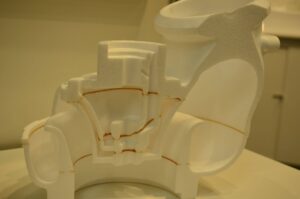
Lost Foam Casting Process – Foam Pattern
Consequently, the LFC Process yields superior dimensional accuracy and smooth surface finish. This is how foundries achieve complex geometries in castings, effortlessly, when compared to conventional investment or sand casting.
Moreover, GDM Technics provides expert consulting with technical know-how to implement LFC profitably, resulting in savings of up to 20-30% in production costs.
The LFC Process: Step by Step
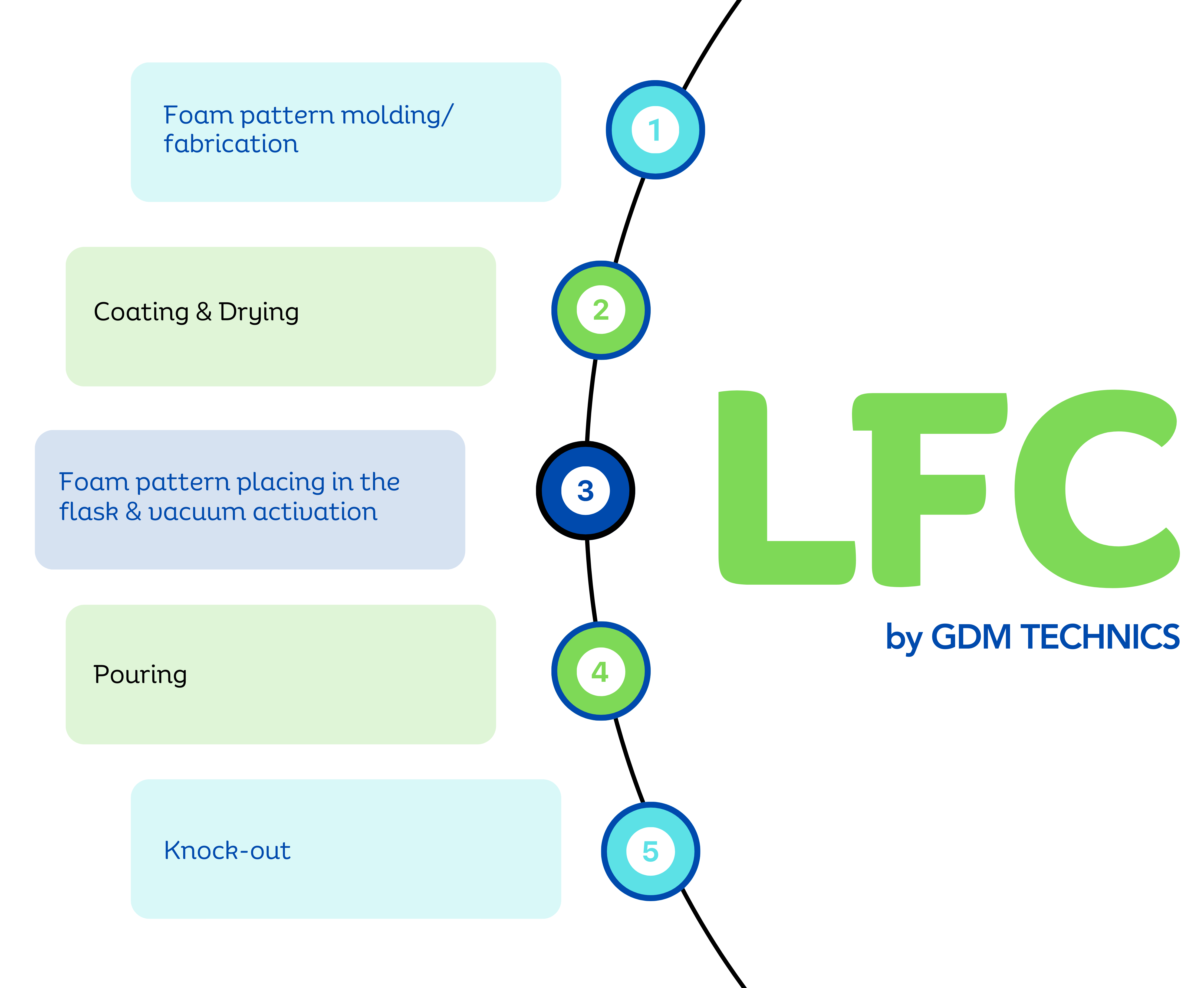
Lost Foam Casting Process
- Pattern Design and Moulding: We engineer and mould EPS foam patterns to mirror the final casting, ensuring precision and repeatability for complex parts. Moreover, our Lost Foam Casting process optimises pattern density and geometry to minimise defects and reduce downstream machining.
- Refractory Coating and Drying: We apply specialised refractory coatings that control metal fill, gas escape, and surface finish in Lost Foam Casting. Then, controlled drying guarantees coating integrity, which enhances dimensional accuracy and casting consistency across large production runs.
- Moulding and Sand Compaction: The coated foam cluster goes into a flask with clean, unbonded sand and undergoes optimised vibration for uniform compaction. Additionally, vacuum assistance improves mould rigidity, delivering cleaner castings and higher yields for Indian automotive and engineering foundries.
- Molten Metal Pouring and Foam Vaporisation: During pouring, molten metal replaces the evaporating foam pattern, accurately forming the near-net-shape cavity in a single step. Therefore, Lost Foam Casting eliminates parting lines and most cores, which significantly simplifies process flow and tooling.
- Knock-out Phase and Finishing: After solidification, we remove the casting, separate the unbonded sand, and recycle it for subsequent Lost Foam Casting cycles. Finally, foundries perform minimal finishing, since LFC already delivers excellent surface finish and reduced machining allowances.
Benefits of Lost Foam Casting Process
GDM Technics delivers Lost Foam Casting benefits through expert turnkey solutions. Foundry owners gain efficiency, precision, and profitability.
-
Cost Savings: Cuts production costs 20-30% by eliminating cores and tooling. Optimises metal and sand usage for long-term profitability.
-
Precision Excellence: Achieves ±0.005 mm/mm tolerances and 2.5-25 µm finishes. Minimises machining for near-net-shape parts.
-
Eco-Friendly: Enables 98% sand reusability without binders. Reduces waste, emissions, and energy by 20-27%.
-
Material Versatility: Supports grey iron, ductile iron, steel, aluminium, brass, and magnesium alloys. Serves automotive, rail, and defence sectors seamlessly.
-
Design Freedom: Produces complex geometries, thin walls, and integrated assemblies. Eliminates parting lines and drafts effortlessly.
-
Faster Throughput: Boosts yields, shortens cycles, reduces defects. Streamlines from pattern to finished casting.
Therefore, the Lost Foam Process stands as the best advanced metal casting process in India. More and more esteemed foundries are joining hands with GDM Technics for Lost Foam Casting Solutions.
How GDM Technics Supports Advanced Lost Foam Foundry Setup
GDM Technics empowers foundries with turnkey Lost Foam Casting Solutions – consulting, product decision, turnkey foundry setup, and manpower training for long-term casting success.
Visit to Learn More: Lost Foam Casting Foundry Setup



4 Comments